
February 5, 2026
Birthright Israel: “If Not Me, Then Who?”


This reflection was written in January 2025, following a Birthright Israel staff mission to Israel. I was there during the release of hostages Romi Gonen, Emily Damari, and Doron Steinbrecher, who had been held in Hamas captivity for more than a year.
I landed back home just 24 hours ago, and I am still in disbelief at what I experienced. I had the privilege of being in Israel during one of the most historic times in modern Jewish history.
The theme that ran through our trip was the conscious decision of the people of Israel to live in constant duality. The Torah teaches us that we are but dust of the earth—a speck of sand—and at the same time, we are meant to live as if Hashem created the world just for us. We live in this tension always: the humility of knowing I am just a speck in this infinite world, and the responsibility that if Hashem created the world for me, then I’d better do something to make it a better place.
The people of Israel live with this duality every day. They go about their lives—shopping, working, raising families—while at the same time carrying in their hearts fallen soldiers, hostages in Hamas captivity, and the uncertainty of a siren or rocket attack. As Dr. Zohar Raviv describes it, this is the “extraordinary power of ordinary life.” I thought I understood what that meant. But being there made me realize I had no idea.
It wasn’t until I came to Israel—until I felt the relief of the freeing of the hostages, and the weight of letting over 1,000 terrorists go free—that I finally understood. Exhilarated, I stood at Sheba Hospital as Emily, Romi and Doron were flown in, while knowing that the terrorist who murdered Ari Fuld had just been released. It is this duality—this humility, this responsibility—that the people of Israel taught me this past week. And this is what we teach our participants on Birthright Israel.
We began our trip at Har Herzl, the cemetery for Israel’s fallen soldiers. At the entrance, Michael, our tour educator, pointed out what appeared to be a dead caper bush. He explained that in the winter, it looks as if it has no life at all. Yet soon it will flourish and grow to more than twice its size. As we entered the cemetery, he asked us to think about renewal, resilience, sacrifice, and offered hope that we will dance again.
Michael pointed out that Yad Vashem, —the Holocaust museum, —is only steps away. He asked us to consider the price we paid for not having a Jewish state—the Holocaust—and the price we pay for having a Jewish state: the sacrifice of our soldiers. He gestured to the road dividing Har Herzl from Hadassah Hospital. Life and death. As tour educators, their job is to leave us with more question marks than exclamation points. You reach your own conclusion. Michael did exactly that.
I’ve toured Har Herzl several times, but this time was different. We stopped at Yitzhak Rabin’s grave, and reflected on the fact that he was murdered because Jews didn’t know how to disagree with civility. It’s become customary for people with political disagreements to visit his grave on his yahrzeit and debate issues respectfully. Birthright groups are brought here and asked to do the same.
Soon after, we met a Birthright Israel group of participants aged 22-26. I had the privilege of speaking with an officer who told me he appreciated being with an older cohort. He shared how we have so much in common and nothing in common at all. He empathized with the American participants for the antisemitism they experienced on college campuses, and they, in turn, worried for his safety and security. As the group walked through the cemetery, I noticed that one participant was deaf, and I felt proud to see him fully integrated into the group. This is Birthright.
We then walked to Golda Meir’s grave. I sat down directly in front of her, overcome with emotion. A group of female cadets walked past us, led by an older woman, followed by two soldiers with rifles slung over their shoulders, protecting them. Watching women of different generations pass by Golda Meir’s grave filled me with a great sense of responsibility. Look at what these women are doing for the Jewish nation…what am I doing?
We walked by Chana Senesh graveside, heard her story, and then made an unexpected turn. Just steps away stood a tent with freshly dug graves. This was a turning point for me. I stared at these graves of young men and women, mostly in their early twenties, surrounded by photos, wedding invitations, lives not lived, children left behind—and my heart broke.
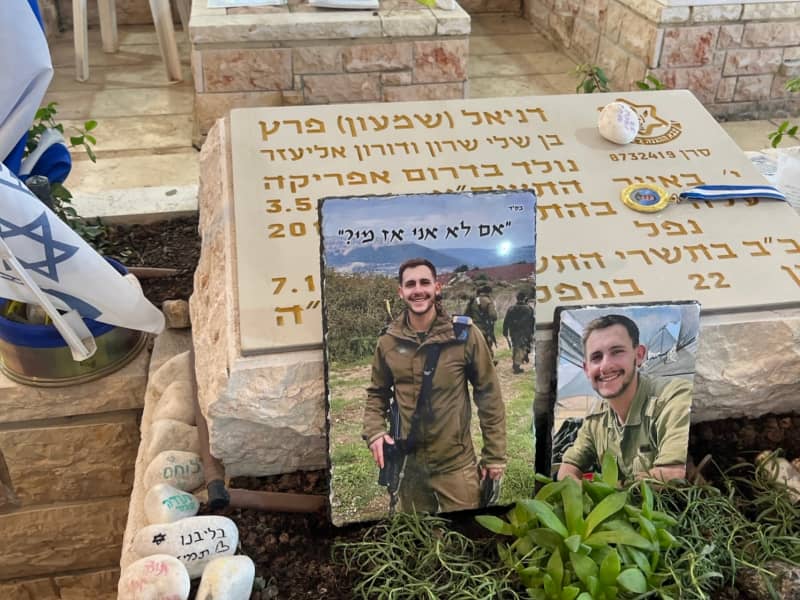
A widow arrived for the end of shiva. A grandmother wept as her grandson was laid to rest. Another life not lived. I found myself standing before the grave of Daniel Peretz. On his gravestone was a picture of him and a quote: “If not me, then who?” If not me, then who?!! I wish it hadn’t been you, nor any other young person. I wish your smile were here with us for another 100 years. If not me, then who? That is what I ask myself.
There is a question asked about the parsha Chayei Sarah—the life of Sarah. The parsha is about her death, so why is it called the life of Sarah? Because when we are born, we haven’t done anything yet. It is only after a lifetime of hard work and accomplishments, of changing people’s lives, that we can speak about “the life of Sarah.” We must ask ourselves not what we are willing to die for, but what we are willing to live for—and as a result, we may have to die for it. We must live our lives to the fullest, with responsibility, and with the knowledge that G-d created the world for me. And if not me, then who?
On my flight to Israel, the woman seated in front of me had a visible physical disability. I tried not to stare, but I did. We are a wounded nation. When we see someone with a prosthetic leg or a missing arm, we stare, and reassure ourselves: that will never happen to me. Yet today, hundreds of people—once healthy and whole—are now living with life-altering injuries, missing legs, arms, eyes. Do we stare? Maybe—but we know they are heroes. They risked their lives for a Jewish state.
And what about those whose wounds are invisible? We don’t stare, we don’t ask, but they are wounded, too. They have lived through a nightmare. It is our obligation to ask questions, to care, to not stare in disbelief, but to look deep into their souls, to connect and let them know they are not alone.
On the train to Tel Aviv, I watched a boy putting on tefillin. A religious female soldier boarded with a siddur in her hand. A girl in front of me sat down and began to pray. The night before, I had been at the Kotel. I love being at the Kotel in the evening, the golden light shining on the stones. It is my happy place. But that night, I couldn’t connect. I was numb. We had just spent the day in the south, and I was still overwhelmed with emotions.
But on the train the following morning, I decided to get up and pray. I found a quiet spot, figured out which direction Har Habayit was, opened my siddur, and proceeded to have one of the most meaningful tefillot of my life. Everyone could see me, but nobody stared. To them, I was just another person praying. For me, it was a moment of pride, freedom and liberation.
This idea—that everyone sees but nobody stares—also carries duality. There are times we must stare, we must ask questions, and we must dig deep into other people’s souls, because their souls need us. We need to be story bearers, not just storytellers. Others are sacrificing their lives for all of us to have a Jewish state. We must tell their story.
But we cannot allow October 7 to define us. We cannot let that day be the Jewish story. Our reaction to it—that is what the Jewish story should be.
On our second day in Israel, we moved from volunteering alongside Birthright Israel volunteers and giving back life, to confronting death in Sderot and Nova, and then back to life again, drinking in a pub restored by our volunteers. We teach resilience to our participants by living it, and I lived it. There is no replacement for lived experience in a digital world.
Birthright Israel is our most important identity formation organization. That means our responsibility is to ensure that tragedy doesn’t become the foundation of Jewish identity. Our participants often encounter narratives that frame Jewish life primarily through victimhood. Our job is to help them not to confuse empathy with identity—to hold space for pain without allowing it to define who we are as Jews. We acknowledge tragedy, but we mustn’t let it become the backbone of our story.