
August 27, 2025
Birthright Israel Onward Was the Best Summer of My Life


I’m a junior at Ohio State from New Jersey. I’m studying finance with a minor in music. Maybe one day I’ll find a way to bring the two together. At school I’m on the Chabad board, and I’m also part of Tamid, a student organization that works with Israeli startups. Through Tamid, I learned about the fellowship that took me to Israel this past summer.
Growing up, I wasn’t super religious. I went to Hebrew school leading up to my bar mitzvah, and then I kind of plateaued after that. My family belonged to Chabad and we went to services on the High Holidays. That was really the extent of my Jewish observance. Back then, I didn’t put much meaning into Hebrew school. But looking back, I’m grateful my parents made me go, because the values I learned there stuck with me. Generosity, and putting someone else before yourself, were the lessons that resonated most. I think about those a lot now, especially after my summer on Birthright Israel Onward.
My internship was at an AI startup focused on predictive maintenance—basically software that can catch small flaws before they become big, costly problems. I worked directly under the CEO, building financial models, and I got to see firsthand how an Israeli company operates. It was a tiny team—only six people—and it was incredible to have so much responsibility so early in my career. I don’t think I could have had an experience like that anywhere else.
But beyond the professional part, what really struck me was the freedom I had living in Israel. I was there as an adult, making independent decisions, working, and experiencing daily life. That independence made me feel so much more connected to Israel. Even something as simple as finding someplace to have lunch became a way to immerse myself in the culture. I tried to never eat at the same spot twice.
One of my favorite weekends was a Shabbaton in Jerusalem. I had never kept Shabbat before, but that weekend I did. No phone, no work. Just rest, community, and connection. It felt amazing. I decided to keep Shabbat every week for the rest of my time in Israel, and it’s something I want to continue as much as I can back in the U.S. I even reached out to my rabbi at Chabad to ask about getting tefillin, and I started saying morning prayers. Those are practices I never imagined myself taking on before this trip.
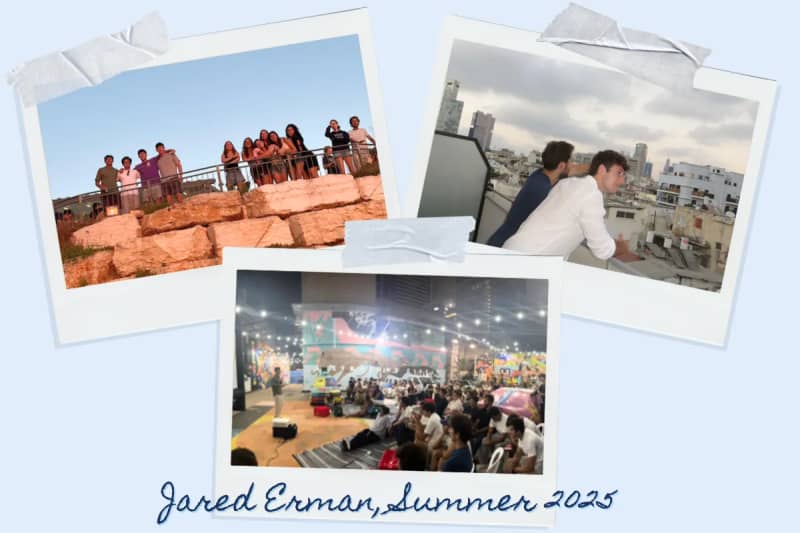
Not all of the experiences were lighthearted. One of the most impactful days was when we visited the site of the Nova music festival. I’ve always been passionate about music, so being there hit me especially hard. There were posts for every victim. Some of them were younger than me. Reading about their lives and passions, I imagined myself in their shoes. It was devastating and deeply moving.
That same day we volunteered on a kibbutz nearby that was attacked on October 7. People were preparing to return, and we helped build greenhouses, dig holes, and put together boxes and chairs. It felt good to contribute, even in a small way. I’ll never forget walking through the kibbutz and seeing blackened rocks where RPGs had hit. Our tour guide would point to a spot and say, “This is where the first rocket landed.” We could hear bombs landing in the distance. The ground shook. It made me grateful for the safety I take for granted in America, and also grateful that I could come to Israel and help rebuild.
There were also moments of incredible resilience. During the war, my group was evacuated. I had only been in Israel for a few days, when the sirens started going off. We sheltered in a hotel basement until four in the morning. The next day, one of our leaders knocked on the door and told us we had five minutes to pack up. We were being relocated to a hotel in Tel Aviv with about 300 other Onward participants.
Throughout the night, sirens would go off every two hours and we’d run back to the bomb shelters. People were scared, watching live streams of missiles hitting the skyline, and there was definitely panic. But at the same time, there was comfort in being together. Someone would crack a joke, their voice shaking, and everyone would laugh nervously. We all leaned on each other. Families whose homes had been destroyed came to seek refuge in the hotel, and I remember one family speaking to us after losing everything. The mother ended her remarks by saying, “We will win.” Hearing that gave me goosebumps. Even in tragedy, there was joy and strength.
After we were sent home, I didn’t know if I would ever get to return. Then, miraculously, just ten days later, we were told the program was resuming. Stepping off the plane again, I felt an overwhelming sense of gratitude. The vibe in Israel had shifted. People seemed exhausted but also relieved, proud, and hopeful.
The second half of the summer was unforgettable. Every day felt like a gift. I kept Shabbat each week. I explored new neighborhoods and food, continued my internship, and took in as much as I could. It was surreal to walk to work past half-demolished buildings, reminders of the conflict that had just unfolded. And yet, the overall spirit was one of resilience, of moving forward, of community.
When I look back on the whole summer—the freedom, the friendships, the Shabbatons, the volunteer work, the evacuation, the return—I know it changed me. It made me prouder than ever to be Jewish and to call Israel home. People sometimes ask me, “How could this have been the best summer of your life? You were in a war.” But I tell them the truth: it was the best summer of my life precisely because of everything we went through. We were given the rare chance to return, to finish what we had started, and to live through something that bonded us forever.
Coming home, I feel more connected to my Jewish identity than ever before. I want to be a stronger activist on campus. I want to speak up for Israel, especially when I see antisemitism and anti-Zionism spreading. I feel more in touch with my religion and more eager to learn. I want to keep praying, to wear tefillin, to keep Shabbat, to carry those values with me. I want to live with the straightforwardness I saw in Israeli culture, where people aren’t afraid of conflict or differences of opinion, and where disagreements lead to solutions.
If I could speak to the donors who made my trip possible, I would tell them it meant the world to me. It’s the most wonderful gift someone can give: the chance to go to Israel, to see it with your own eyes, to live it, to come back changed. It is impossible to spend a summer in Israel and not be transformed. For me, it was the best summer of my life, and I’ll carry it with me forever.
Related Posts

Birthright Israel Summer 2024 Program Snapshot
Did you know that 13,500 Jewish young adults will take part in Birthright Israel programs this summe...
True Life: My Birthright Israel Story
The first time I traveled to Israel was when I was fourteen and then most recently with Birthright I...

How my Birthright Israel trip helped me save a life
More than two years ago, when I signed up for a Birthright Israel trip with fellow students from The...

An Overview of the Onward Israel Program
At the beginning of 2022, Birthright Israel announced its merger with Onward Israel. Onward Israel i...