
August 22, 2025
Birthright Israel Showed Me a Proud Future I Never Imagined
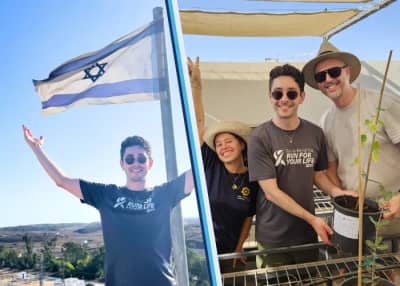
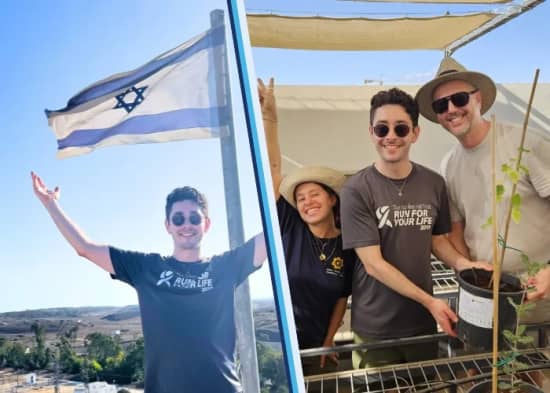
I’m from Manchester but have lived in London for 7 years. I am passionate about writing, particularly writing about being gay and Jewish. My short film Sinnerman—about two gay Jewish men—was selected for the BAFTA-accredited UK Jewish Film Festival, as well as 6 other film festivals. I am currently writing a feature film about a similar topic.
My connection to Judaism has always been strong. I grew up in a Modern Orthodox family and went to Jewish nursery, primary school and secondary school. Later, I went to a university with a large Jewish community, and I attended yeshivah in Jerusalem for a short time in my early twenties. When I came out as gay, I initially struggled with the intertwining of my Jewish and gay identities. However, over the years I’ve found that intersection to be a lot easier thanks to community groups such as Hineni, which was recently founded for queer Jews in the UK to celebrate their identities, and charities such as KeshetUK, which exists to help people live authentically as both queer and Jewish.
I was inspired to go on a Birthright Israel Volunteer trip for LGBT+ participants because I was desperate to go over and do something to help. I couldn’t get much time off work, so this trip was the perfect way for me to volunteer in Israel. I’d also found it extremely difficult being part of the wider LGBT+ community in the UK. Many have been very vocal in their anti-Israel—and at times antisemitic—ideologies. The idea of being with a group of Jewish queer people in Israel sounded like a great escape.
When I first arrived in Israel, the thing I noticed immediately was a feeling of relief. My shoulders finally relaxed, after almost 2 years of being on high alert in the UK. When I left Ben Gurion Airport and saw graffiti on the wall, my stomach automatically dropped because in the UK, when graffiti mentions Israel, it’s almost always hateful. Here, it wasn’t. Though it’s perhaps a relatively small thing, seeing graffiti that wasn’t inciting terrorism or featuring antisemitic imagery was a symbol of something much bigger.
I absolutely loved all the volunteering. We packed boxes of food, painted the walls of an LGBT+ center, and planted trees in Sderot. However, for me the two biggest moments were visiting Hostage Square and attending a gay-run Orthodox shul for Kabbalat Shabbat.
We had visited the Nova site and Sderot during the week, which were heavy but expected. What I didn’t expect was the overwhelming emotion I felt at Hostage Square on Saturday night. Being surrounded by thousands of Israelis, commemorating the hostages who had been killed and demanding the release of survivors was something I can’t really describe. Watching from the UK over the last 2 years, I had felt somewhat removed from the intensity of the situation. But being there with everyone truly felt as though we were one family, all sharing the same grief. I found it overwhelming in a way I really hadn’t expected.
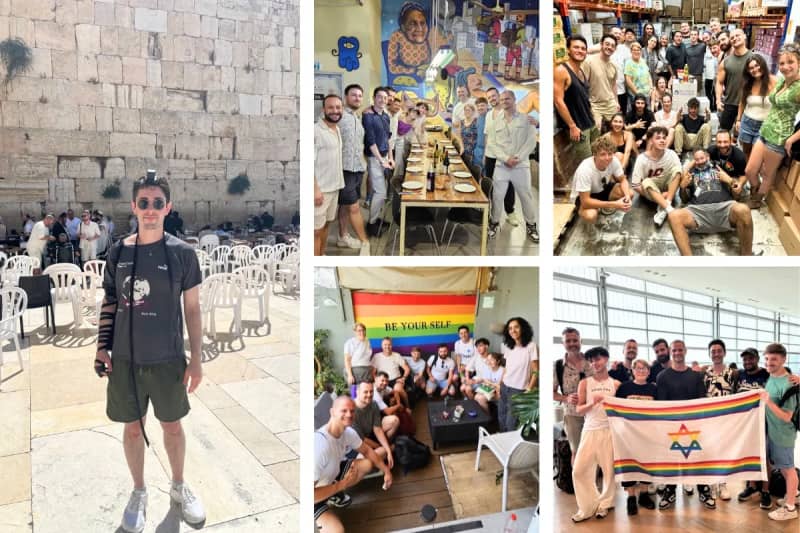
The other highlight for me was attending shul on Friday night. That day in Jerusalem, I prayed at the Kotel for the first time in 10 years, this time praying as a much happier, openly gay man. That evening, I was asked to make Kiddush for the group by our tour leader, which was a really special and proud moment for me. We then attended a shul that was gay-run, where around half the congregation were LGBT+. I’d never in my life been in a Jewish space that is both Orthodox and gay, and I felt my life shift during that evening. I sang the songs and followed the service I grew up with, surrounded by fellow gay people. I couldn’t believe it. After the service, I was chatting with a gay couple who had their children with them. I told them that they are living my dream. They said the dream could be mine if I made Aliyah!
I hadn’t gone to Israel thinking about Aliyah in the slightest. Truthfully, my experience 10 years prior at yeshivah in Jerusalem did not make me want to live there at all. But I found myself slowly, day by day, realizing that perhaps Aliyah wasn’t something that was totally out of the question. The first sign for me was that feeling of relief after landing at Ben Gurion, knowing I wouldn’t be seeing stickers and posters all around me that support terrorism or call for the annihilation of the Jewish state. Next, I found myself speaking Hebrew far more confidently, each day learning a little bit more, thanks to Google Translate. Hostage Square made me feel part of the wider Israeli family. And being at the gay Orthodox shul made me feel like part of a very specific and special group within the family.
On our final night, we went to a Eurovision party, where a group of Israelis performed a medley of Eurovision songs all night. I had a smile on my face as the entire room danced and sang, wrapping themselves in Israeli flags—ironically, while performing songs by artists who had been critical of Israel. I felt as though I had my gay community back. As I added all of those things up, I knew that I had to at least consider Aliyah as an option.
Our trip was short, but the experiences were varied and eye-opening. We felt shockwaves from explosions as we sat in a Kibbutz 2 kilometers from the Gaza border, listening to stories about the heroes who saved the Kibbutz from Hamas terrorists on October 7th. We danced and made mosaics with elderly ladies in Holon, chatting with them in broken Hebrew, enjoying the music together. One night, at a party in Tel Aviv, one of the songs that came on was “Titanium” by Sia. I had to stop for a moment and look around, as all these young people around me belted out the lyrics: “I’m bulletproof, nothing to lose, fire away fire away, ricochet you take your aim, fire away fire away, you shoot me down but I won’t fall, I am titanium.” To them, they may have felt they were just singing a fun song. But to me, they were singing an anthem that represents their resilience and strength. It’s moments like that which will stay with me forever.
If I could speak to Birthright Israel donors, I would say thank you for changing my life in a way that I could never have predicted. Whether I move to Israel for a year, 10 years, or the rest of my life, I will forever be grateful for my Birthright Israel experience. It opened my eyes to the possibility of a future I would never have otherwise imagined.
Related Posts

Can Birthright Israel Truly Strengthen the Jewish Future?
You may have heard us say this before: Birthright Israel is strengthening the Jewish future. But Wha...

Future Birthright Israel Parents and Participants Remain Hopeful
The world has drastically changed since the outbreak of the novel coronavirus. We look around us and...

Why Future Birthright Israel Participant Isabelle Remains Hopeful
As Birthright Israel entered its 20th anniversary year no one could have imagined a global pandemic ...
Birthright Israel Foundation Launches Fund for the Jewish Future
New York (February 3, 2025) -- Birthright Israel Foundation announces the launch of the Birthright I...