

October 16, 2025
Finding My Musical Jewish Voice Through Birthright Israel Storytellers
I’m a trumpet player and teacher based in New York City. I play on Broadway and on tours around the world, and I also perform as a soloist. I love commissioning new works by composers and performing music that’s about the issues I care deeply about—women’s rights, climate change, social justice.
I didn’t grow up with any Jewish background or community at all. I’m from the Washington, D.C. area—technically Bethesda, Maryland—and my family was totally secular. We didn’t celebrate the holidays except maybe Hanukkah when I was a child, and even that was just lighting candles without really understanding what it meant. The words “Israel” and “Judaism” were not really spoken so often in my house.
I went to public school, had Jewish friends, and went to their Bar and Bat Mitzvahs, but I didn’t have one of my own. I went to NYU for undergrad, which would have been the perfect place to explore Judaism, but I was focused on my career. I was practicing, performing, and networking all the time and just laser-focused on making it as a professional musician.
Then during the pandemic, I saw something about Birthright Israel, and I realized it was my last chance to go—I was at the upper age limit. I thought, “Why not? It’s free, and I should probably see what this is all about.” I had never left New York for more than a few days because I was terrified that if I left, I’d miss work and lose opportunities. But something told me to go.
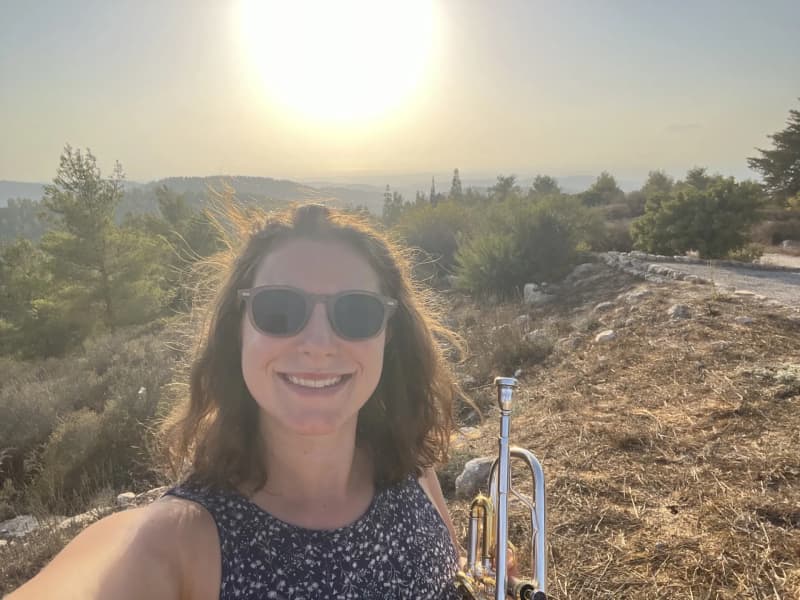
That trip in 2022 truly changed my life. I didn’t know what to expect. I went in totally blind, no friends on the bus, just a desire to learn what Jewish life and Israel were all about. Once I got there, I was like, oh—this is Judaism. This is Israel. I was surrounded by people who were exploring the same questions, who were learning, connecting, and celebrating. The trip was filled with so much fun and friendship and so much meaning. We’d talk about everything from “What is God?” to “Why do bad things happen to good people?” It was the first time I had deep Jewish conversations with people my own age.
Then came October 7th. At that time, I was on tour and living on a bus, performing back-to-back shows. When the news broke, I just remember being in shock—watching the footage, reading updates, crying between performances—and feeling like no one else around me cared. Only one person came up to ask if my family was okay.
It was such a lonely feeling. I thought, how can people not be outraged? How can they not feel this? These were other women, other musicians—people who should understand what it means to be moved by human suffering, especially from those attending a music festival. But instead, there was silence.
When I started posting online about it, I got hate messages. People in the music world told me to stop. I realized that a lot of my colleagues didn’t want to hear from a Jewish artist who cared about Israel. And that was terrifying, because as a freelance musician, I only get paid when people hire me and I don’t want my views to alienate me from my colleagues in New York City.
So I stopped posting. I hid that part of myself for months. I kept playing Jewish events—I’ve played at so many Orthodox women’s concerts and community gatherings, and I always love those gigs—but I stopped talking publicly about Israel or being Jewish. I just felt scared.
But that silence didn’t feel right either. I needed to find a community of people who truly understood, both online and in person—people who were proud, informed, and ready to speak up.
That’s when I found Birthright Israel Onward: Storytellers. When I read the program description, I felt like it was written for me. It was about connecting Judaism to your art, learning how to share your story, and finding your authentic voice. It combined everything I was craving: a community of creative Jewish peers, a space to learn, and the tools to speak openly and proudly about Israel and my identity.
I wanted to learn how to be vocal again—how to post confidently, how to engage meaningfully, and how to explain my positions without fear. I wanted to understand the facts, the nuances, and the language so that when people messaged me hateful things online, I’d be ready to respond with truth and clarity.
The trip gave me exactly that. We learned from incredible educators—experts who live and breathe this work, who walked us through the conflicts, the history, and the complexity of it all in a way that felt empowering, not overwhelming. We met with other artists and people who have fought for their Judaism and for Israel both in person and on social media. We talked about crafting our Jewish journeys—about who we were before October 7th and who we’ve become since.
But the best part was being with other artists who get it. We had a performing arts session where we all talked about the challenges of being Jewish creatives today. Every single one of us felt afraid to post what we really wanted to say, afraid of losing work, and afraid of being misunderstood. We identified the problem together and asked: what’s the solution? How can we use our art to tell our truth?
That conversation changed me. It reminded me that music has always been how I express myself yet I wasn’t going to spark change from posting about the issues, but could reach people through music. My second album, which came out in 2020, was all about social and political issues. I’ve always believed music can move people to care. So why not use it to express my Judaism, too?
That’s how my Jewish music project began. Half my family is Sephardic, and I’d started exploring Ladino songs—these beautiful, soulful pieces that carry centuries of Jewish history. I realized that playing and recording them could be a bridge—something everyone can appreciate, whether they’re Jewish or not. Music opens hearts and can start conversations.
So now, I’m working on two kinds of projects. Some are specifically for Jewish audiences—teaching and performing songs that people might have wished they learned as kids but never did. Others are broader—songs about gratitude, nature, love—Jewish in spirit and origin, but universal in theme. Either way, they’re ways to share the beauty and depth of Jewish music with the world.
Storytellers helped me do that. It gave me the confidence to post again—to share, to educate, to engage from a place of knowledge and pride instead of fear. It gave me a supportive community of artists and educators who are “here for it,” who care deeply about being Jewish in this moment, and who inspire me every day to do the same.
If I hadn’t gone on Birthright Israel, I don’t think any of this would have happened. I wouldn’t be traveling the world as a professional musician. I wouldn’t have found such a warm, passionate Jewish community—online, in person, and across the globe. And I definitely wouldn’t have the confidence to share my voice, both musically and personally, with pride.
Everyone on the trip talked about how each of us needs to find our own way to express what it means to be Jewish today. We’re not all meant to say or post the same things—we each have to find a way to share our beliefs authentically.
When I play Jewish music—when I perform a Sephardic lullaby, or a piece like Kurt Weill’s “Youkali,” about an imaginary island of peace that might never exist—it’s my way of saying: we’re still here. We create, we persevere, and when encountering difficult situations, we make beauty out of pain.
That’s what being Jewish means to me now. And that’s what Birthright Israel and Storytellers gave me—the chance to find my voice, to use my art to share light, and to stand proudly as who I am.
Related Posts

Finding My Jewish Identity Through Birthright Israel Excel
As a child, being Jewish was easy– mostly because it was gently forced upon me by my loving parents ...

Finding My Place and My Voice on a Birthright Israel Trip
Where I grew up in rural Oregon people denied the Holocaust. I experienced a lot of antisemitism fro...

Birthright Israel Honors Jewish Leader and Philanthropist Jeff Solomon
On December 12, 2024, Birthright Israel Foundation and its friends and supporters gathered at the Ha...

Can Birthright Israel Truly Strengthen the Jewish Future?
You may have heard us say this before: Birthright Israel is strengthening the Jewish future. But Wha...