

April 20, 2026
From Four Jews in Texas to Thirty on a Birthright Israel Bus
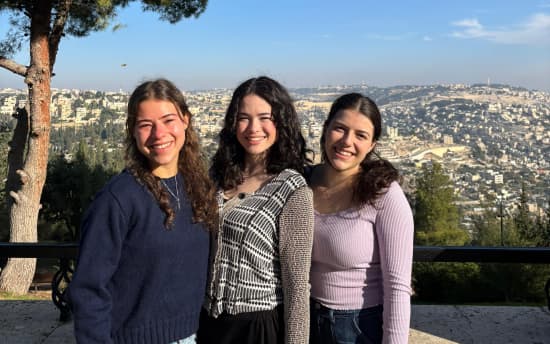
I am a third-year Health Sciences major from Solon, Ohio, and the Vice President of Administrative Affairs on Ohio State Hillel’s student executive board. I grew up in your average American Jewish household, which is to say that, for as long as I could remember, my parents, grandparents, aunts, and uncles all told me I needed to go on Birthright Israel. I always knew I would, and this past December, I finally did.
What’s important to know about me, though, is that while I grew up in an average Jewish household, the location of that household was anything but average. In 2016, my family moved to Canyon Lake, Texas—a town whose Jewish population went from zero to four the day we arrived.
What I did not know then is that a Jew cannot be Jewish alone. We are a people above all else, and our strength and resilience in numbers is the very reason we’ve survived this long. When I faced antisemitism from my peers in Texas on probably a weekly basis, I learned the hard way that more than anything, it would be nice to have some Jewish friends! I persisted and I survived, the way Jews always have. I tried to shake off the gas chamber jokes, the Hitler references, the money accusations. But my only support was my family, and we may as well have been stranded on a deserted island.
Birthright Israel lingered in my mind throughout those years. Hillel did, too. I knew there had to be a community of young Jewish people out there; I just needed to find them. It wouldn’t be until 2021, when we left Canyon Lake for Cleveland, Ohio, that I’d finally meet them.
The beautiful thing about Birthright is that it doesn’t matter how Jewish you grew up. Canyon Lake Jew or Cleveland Jew, you’re still a Jew. What I loved about my bus was that the 31 Americans on the trip came from all over the country and from every background imaginable. There was an Argentinian Jew playing college soccer in the U.S.; an Israeli Jew whose parents had immigrated to Ohio who was in the process of getting his American citizenship; and a brother and sister from California who attended different schools but still took the trip together. Half the bus was from California—San Diego, LA, Berkeley—people I never would have met otherwise.
Birthright Israel, to me, was so much more than seeing Israel. Under the protection of our tour guide Oren and our security guard Ofek, we were free to simply experience—something that I, as a very Type-A person, rarely allow myself. Seeing Israel is one thing; experiencing it is another.
Experiencing Israel means having little girls on a kibbutz fight over who gets their hair braided by you. It means tightly hugging someone you met four days ago as you both sob in Yad Vashem. It means making small talk with a shopkeeper in the Old City who wants nothing more than to see you make Aliyah. Most importantly, it means experiencing the vast community of Jews that makes Judaism what it is: the exact community I dreamt of when I was growing up.
Birthright Israel is as meaningful as it is because of the people you share it with. You watch thirty young Jews, most of whom had never met before, become inseparable over the course of 10 days. I’ve never been around a group of people who generated more inside jokes in such a short span of time, many of which can be attributed to Avraham Infeld— President Emeritus of Hillel International and Director of Planning for Taglit Birthright Israel—perhaps the best speaker I’ve ever heard.
I was blessed to be in Israel during a short, sweet pocket of time between two wars. I cherished every day I spent there, while quietly cursing each day for having the nerve to end. I gained perspective not only on Israel, but on the many different ways young people perceive Israel and their own Judaism. I shared bits and pieces of my story—of the time I was the lone Jew on an island in the Lone Star State. I learned the stories of others: the boy who grew up Jewish because his mother had converted him and his sister when they were young; the IDF soldier whose entire family was in London except for her; even Oren, our tour guide, leading his very first Birthright trip since before COVID-19.
I cherish all these stories because Judaism is, above all, a people. In the ten days of the trip and the months since, Birthright Israel has become such a core part of my Jewish identity. It has given me a once-in-a-lifetime opportunity to surround myself with the purest microcosm of Jewish peoplehood—both from the U.S. and Israel—with all the stories, perspectives, and experiences that come with it. I returned home a better leader with a more accurate, well-rounded perspective of Israel—its history, its people, and its conflicts. You can never truly understand Israel until you experience it yourself. Birthright Israel gave me the most incredible opportunity to do just that.