

August 22, 2025
Helping Farmers and Hostage Families as a Birthright Israel Volunteer


I grew up in Montreal in a home where we didn’t need to be told why Judaism mattered; it was ingrained. My parents and grandparents set the example. Every Friday night, without exception, we had Shabbat dinner. We weren’t strictly Shomer Shabbat, but family always came first.
From the time I was little, Israel was part of my life. My mother worked for Combined Jewish Appeal in Montreal, and I spent time there and at the Holocaust Center in the same building. Growing up Canadian, I always felt I was a Jewish Canadian, not a Canadian Jew. By the time I was a teenager, I knew I wanted to marry Jewish and raise Jewish children who loved their heritage and loved Israel.
At 19, I went to Israel for the first time to live on a kibbutz. I studied, worked, and traveled, and I loved every minute of it. Later, in my 20s, I returned for more volunteer programs, painting buildings in Tzfat and helping with construction near the Jerusalem tunnels. I didn’t go to Israel to find my Jewish identity — it was already there. I went because I wanted to live it, to get my hands dirty, to be part of building Israel.
That same drive is what brought me back after October 7. I didn’t want to tour. I’d already seen the Dead Sea, Masada, Jerusalem. What I wanted was to help. To stand shoulder to shoulder with Israelis and do the work that needed to be done.
I signed up for Birthright Israel Volunteer this past summer. My first trip, scheduled for June 30, was canceled when the war with Iran broke out. I was disappointed, but determined. When I had the chance to reschedule for July 20, I took it — just days before my 51st birthday.
Our group was unusual: 38 participants, ages 18 to 50. At first, it was a shock. Some of us could have been the parents of the youngest participants. But it turned out to be wonderful. We were role models for them, and they gave us energy. We found our natural groups — the moms, the dads, the college students, graduate students and young professionals — but when it came time to volunteer, we were all in it together.
The first two days we worked in Tlalim and Netivot, pulling weeds in greenhouses growing tomatoes and cucumbers. It was brutally hot and tedious, but it mattered. With laborers gone after the war, farmers simply couldn’t keep up. Our work gave them back days of labor. In the distance we could hear booms coming from Gaza — at first jarring, but eventually just part of the day. Later, we visited Sderot and the Nova site. It was an incredibly long, emotional day.
Everywhere we went, Israelis stopped us: “Thank you. What are you doing here?” And when we told them we were volunteers, not tourists, their gratitude was overwhelming. We knew our presence mattered. Even when it felt like just weeding or packing boxes, we were reminded: this is someone’s livelihood. What we did in hours would have taken them days.
Other days we packed food for impoverished families, walked hospital corridors with a coffee cart to comfort patients’ relatives, prepared Shabbat meals, and delivered letters from kids in New Jersey to wounded soldiers. It wasn’t glamorous — sweaty, messy, exhausting — but that was the point. We weren’t there for comfort. We were there because Israel needed us.
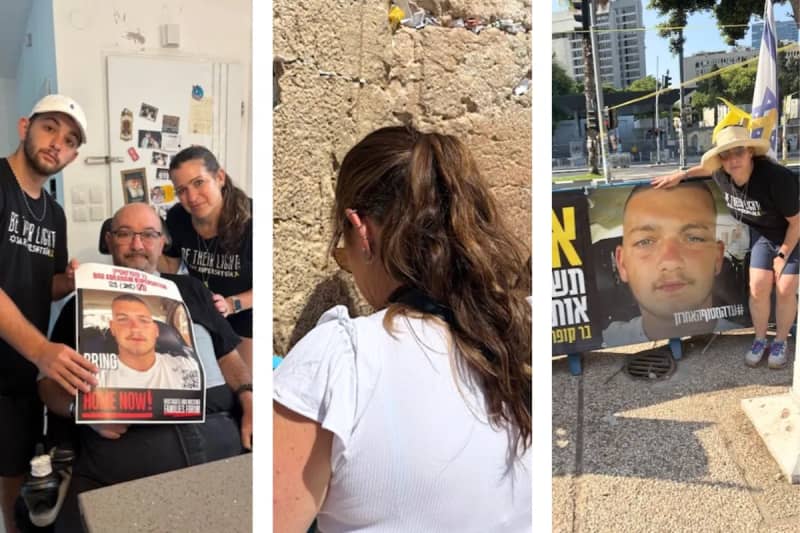
Visiting the Nova site and Hostage Square were especially moving. I already had a personal connection: I’d been helping bring a Nova survivor, Din Tesler, to New Jersey to speak about his best friend Bar Kupershtein, who is still held hostage in Gaza. I’d also become friends with Bar’s brother Dvir. When I went to Israel, I made sure to visit their family, to sit with them and bring comfort. At Nova, when I saw Bar’s green beret at the memorial, I broke down sobbing.
At Hostage Square, they say: adopt a hostage. Choose one, learn their story, and share it. Bar is mine. His family’s story became part of my own. Walking through the square with my group, and returning on my own later, were some of the most powerful moments of my trip.
What struck me most was the bond we built in our group. Being with 18- and 20-somethings just starting their Jewish journeys, while I was bringing decades of my own experience, was beautiful. We learned from each other. They reminded me of the urgency of their generation, and I reminded them that Jewish life is long, with many roads to walk.
Back home, I talk about Birthright Israel all the time. Some people say, “Oh, it’s a free trip.” I correct them right away. It’s not free. It costs something, and donors make it possible. Every dollar counts. My friends and I give to Federation, and we also give to Birthright Israel because it’s our future. This generation — Gen Z — needs Birthright Israel more than ever. They need the tools to stand proud as Jews, to advocate for Israel, and to teach their peers.
For me, the Volunteer program wasn’t about changing who I am. I’ve always been proud, always been deeply connected to Israel. It was about showing up, rolling up my sleeves, and being part of Israel’s story now, in this moment.
I came home grateful that Birthright Israel created this opportunity for people my age, grateful that I got to contribute in meaningful ways, and grateful for the reminder that the Jewish people are one family.
Would I do it again? Absolutely. In a heartbeat.
Related Posts
Lone Soldier Families Reunited in Birthright Israel Volunteer Ceremony
Last week, our Birthright Israel Volunteer program had the privilege of welcoming an extraordinary g...
Finding Hope and Purpose As a Birthright Israel Volunteer
When I was a kid, my family moved around a lot — from Mexico to Vancouver, eventually settling in Ho...

Video: Inside Birthright Israel Onward's Volunteer Program
Following the horrific October 7th attack, Birthright Israel Onward invited alums of all Birthright ...
Birthright Israel Invites Alumni to Volunteer in Harvesting Abandoned Fields
NEW YORK — After sending 850,000 Diaspora young adults on free educational trips to the Jewish state...