

August 27, 2025
My Zionism is Unshakable Thanks to Birthright Israel Excel


I am a senior at Harvard studying Applied Math and Computer Science. I was born and raised in Newton, Massachusetts. My mom is Ashkenazi Jewish. Her entire family, for centuries, are Ashkenazi Jews from Budapest, Hungary. It was and had always been their home. Of course, this changed with the Holocaust—most of my mother’s family were robbed of their homes, crammed into ghettos, deported and butchered. My grandparents survived, met and married in college. In the late 1960s, they escaped from Communist Hungary to Paris, sponsored by distant relatives in the U.S.
I was raised by my mother and grew up Reform. We attended Temple Beth Zion in Brookline, and later Temple Shalom in Newton. Yet, it turns out my real religion is soccer (kidding). I played for the New England Revolution Academy and the United States Youth National teams. Most of my young life consisted of Friday night flights and bus rides, games on Saturdays, and food pitstops where inspecting every single ingredient would’ve left me with an empty stomach. So, being Shomer Shabbos and Kosher was not an option.
The Holocaust was a central pillar of my Jewishness. My grandmother’s testimony was filmed for the Yale archives. It was imperative for us to watch it during special family gatherings. I grew up hearing about her enslavement, but also about her resilience and strength. As a starving child, she stole sugar, trying to scrape together food for her family. She darned fellow forced laborers’ shoes with bits of leftover leather in a leather factory. She was on a train to the death camps, but her life was saved when the tracks were bombed by the Allies. All in all, my Jewish identity was really the Torah, the High Holidays, and the Holocaust.
Israel honestly wasn’t something I thought about growing up. To me, it was a concept from the Torah, the promised land of a 40-year journey through a desert. Perhaps it was ignorance, youthful naiveté, the fact that I don't have any family in Israel, or all of the above. But I never grasped the fact that the Jewish homeland was more than just a word uttered during a sermon, or the focus of a prayer.
At the end of my freshman fall, I went on Birthright Israel through Harvard Hillel. That trip was transformative. It was my first time in Israel. My first time realizing that there exists a modern J ewish homeland—that’s not Williamsburg or Brookline. Being at the Kotel for the first time was reflective: I thought about the thousands of years of Jewish history. The resilience of the IDF to repossess the Kotel and the surrounding land, a resilience so familiar in my family history. Standing in the Jewish land after all the trials and tribulations of our people. Looking back, I am reminded of what my great-grandfather said when goaded to convert: “Judaism is not a coat you put on in the winter and take off in the spring.”
Other moments standout as well: looking from the hill in Jaffa at the Tel Aviv skyline, marveling at Jewish ingenuity and perseverance. A hundred years ago, Tel Aviv was all sand, and now it’s a thriving city. For me, growing up with Holocaust stories—constant reminders of Jewish suffering—being in Israel felt like the complete opposite. This was resilience, this was happiness, this was innovation. This was my spiritual awakening. I felt like I was part of a 6,000-year-old story. I felt connected to my grandmother. I never met her, but I felt like she was right there with me at the Kotel.
Then October 7 happened, and that was shattering. I had been to Israel. I had Israeli friends. I now had a personal connection to the land and people where this massacre had occurred. It was a painful reminder that this is what it really means to be a Jew.
Back on campus, it was chaos. Students chanting genocidal slogans like “from the river to the sea.” First-Year proctors saying all Zionists should die. People excusing terrorism, mass rape, and pillaging as resistance. I even found myself questioning Israel because of how strong the propaganda was. Harvard was under a magnifying glass. The Harvard president, in Congress, stated that categorizing calls for the genocide of Jews as harassment “depends on the context.” News outlets called Harvard Hamas HQ. That’s how toxic it was at Harvard. It broke my heart. I was juggling all that while being a student-athlete. I realized I had to step up . I wanted to make my ancestors proud, to advocate for the Jewish people, to be a spotlight for truth.
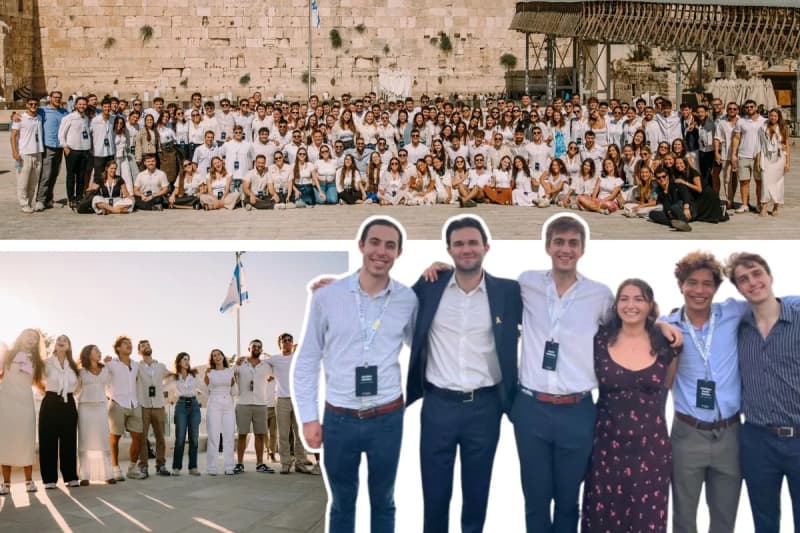
That’s what put me in the mindset to apply for Birthright Israel Excel. And honestly, it turned out to be the best summer of my life. There are three reasons Excel was so incredible. The first is the Israelis. Having 80 Israelis in the program made all the difference. Each of them was my superhero. They had fought for Israel—intelligence roles, combat units, pilots—and defended the land. They had done things you’d see in movies. They were true Jewish warriors, like the Maccabi I had grown up learning about and revering. Yet, the Israelis were so humble, so selfless, and true embodiments of the principle of paying it forward. They were also incredible people with passions of their own. Nadav, teaching me the intricacies of both Calisthenics and Quantum Computing. Maya, with her Machine Learning expertise, love for Pistachio Chocolates, and taking me to her family Shabbat BBQ. Or Gili, enlightening me to the strategies of Shesh-Besh (Backgammon) whilst we sunbathed for hours at Gordon Beach. I had experiences and built relationships with the Israelis that I will cherish for the rest of my life. Being with the Israelis also re-instilled what I felt on my first Birthright trip: the fact that I’m just one part of something so much bigger.
The second is the internships. I worked at Viola Credit. I ended up loving every second. In just 20 days, I presented the first screening of a $75 million opportunity to the rest of the team, analyzed data, and had my insights incorporated into their work. The culture was incredible—collaborative, respectful, relaxed. Nothing like the cutthroat image and “every man for himself” stereotype of American finance. This experience with Viola gave me professional skills and confidence I’ll carry with me for the rest of my career.
The third is the community. Living at Bnei Dan together, staying up all night having courtyard conversations and Tanakh deep dives, celebrating two bat mitzvahs at the Kotel—those moments showed me that no matter our backgrounds, we are all part of the same 6,000-year story. I walked away with 159 new family members. Truly, they’re such close people in my life now. The fact that the global Excel Fellows returned to Israel after they were forced to evacuate during the war with Iran shows the strength of the bonds in our community.
Excel changed me in every way. It taught me the value of giving and keeping the ladder in place for others. It gave me clarity about my professional path. It reinforced the importance of resilience. And it deepened my connection to Israel to the point where I’m seriously considering making Aliyah, working in Tel Aviv, or even serving in the IDF. My Zionism is unshakable now.
It also gave me a global network. Now I know I have family in Mexico City, Brazil, Munich, London, Toronto, Los Angeles—and they all have a home in Newton, Massachusetts.
If I could meet the donor who made my trip possible, I’d give them a hug and probably cry. No words can do justice to this experience. What they’ve given me is a lifelong commitment to the Jewish people and to Israel.
To anyone considering supporting Birthright Israel, I’d say this: think about the most impactful Jewish experience of your life. Now imagine giving that feeling to thousands of young Jews every year. That’s what Birthright Israel does. It changes lives. It changed mine. It gave me family, purpose, and the strength to be a proud Jew and a proud Zionist for the rest of my life.
Related Posts

Igniting the Spark of Leadership: Birthright Israel Excel
Imagine a summer program that ignites the spark of leadership in young Jewish business minds. A prog...

Taking My Birthright Israel and Excel Experiences to the Next Level
We recently had the chance to catch up with Avery Rosin, Birthright Israel and Birthright Israel Exc...

Finding My Jewish Identity Through Birthright Israel Excel
As a child, being Jewish was easy– mostly because it was gently forced upon me by my loving parents ...

Birthright Israel Summer 2024 Program Snapshot
Did you know that 13,500 Jewish young adults will take part in Birthright Israel programs this summe...