
October 10, 2025
One Week Changed Me on Birthright Israel Volunteer
I’m from Long Island, New York. I’m in my third year at Binghamton University, majoring in economics, and I love it here. Binghamton has a strong Jewish community, which was a big reason I chose it. I wasn’t very religious when I was younger, but over time, my family became more observant. My sisters and I went to Jewish day school our whole lives. As we learned more, my parents started keeping kosher and Shabbat, and our family became more involved in Jewish life.
After high school, I decided to take a gap year to learn at a yeshiva in Israel. My mom always said, “It’s Israel—it’s our home.” She believes every Jewish person should spend real time there. I wasn’t sure at first, but it turned out to be the best decision I ever made.
That year changed my life. I learned more about Judaism and about myself. I grew spiritually and personally. Shabbat became something I loved. Back home, it wasn’t easy to keep Shabbat as a high school kid, but in Israel, surrounded by Jews my own age, it was natural. We’d sing, learn, and talk all night, not caring about phones or social media. I found a real reason to keep Shabbat for myself.
I also learned to wrap tefillin every day, something I hadn’t been consistent with before. On a trip to Poland, I heard the story of a man who refused to leave his tefillin behind during the Holocaust. He risked—and lost—his life for it. That story changed me. I realized if he could die for that mitzvah, I could spend two minutes a day doing it.
Since that year, I’ve tried to find ways to return to Israel. The feeling when I land at Ben-Gurion Airport never gets old. It’s lighter there. More hopeful. There’s a sense of pride and belonging that’s hard to describe. In Jerusalem especially, I look up at the Kotel and feel at peace. The world may be chaotic, but in that moment, I feel safe. I know people are standing guard, protecting us. It’s powerful.
Tzfat is another place I love. The spirituality there feels different—very deep, very pure. The blue and white buildings remind me of the sky. Mitzpe Ramon near the Dead Sea is stunning, too. But Jerusalem will always be my center.
This past year, I went back for a one-week volunteer trip through Birthright Israel. A few friends from Binghamton encouraged me to go. I’d been wanting to return to Israel and to help after the war. People talked about how farmers needed help harvesting because so many workers were gone. That’s exactly what I wanted to do—to give back with my own hands.
Our first project was food packaging. We sorted crates of vegetables—potatoes, peppers, avocados—good ones into sets, bad ones to another pile. Later we learned the good produce went to over 400 families around Jerusalem, and the rest was turned into soup so nothing went to waste. There were only about 35 of us, but in one afternoon, we helped feed hundreds of families for Shabbat. It showed me how even a few hours can make a real difference.
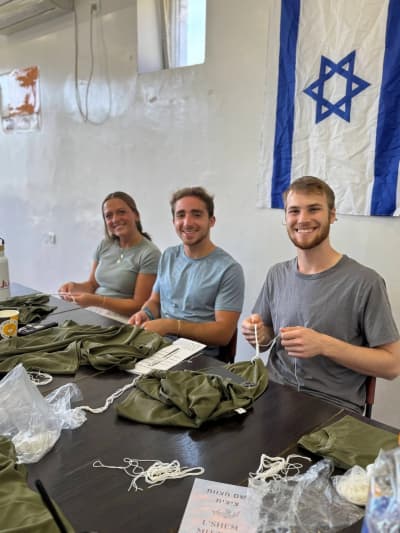
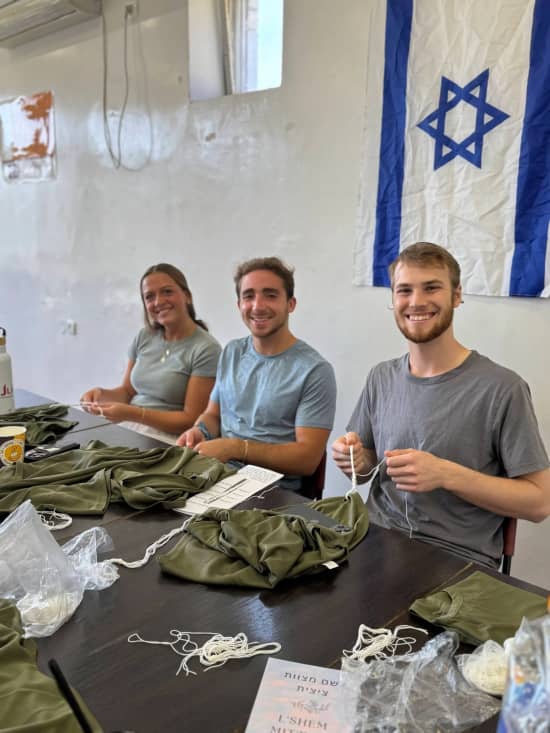
We also made tzitzit for soldiers. We learned it’s the second most requested item in the army. The shirts we made were comfortable, athletic material—and fire-resistant. We were told a story about a soldier who survived an explosion because his tzitzit helped protect his chest. It gave me chills. Knowing something we made could help a soldier like that—it meant a lot.
Then we went south to pick raspberries on a farm that had been attacked on October 7th. Around thirty people were killed there. The woman who ran it lost her husband, friends, and workers. It was brutally hot under the tarps, thorns everywhere, but we pushed through. She told us our help made a real difference in how much they could harvest.
We also volunteered on a lemon farm. It wasn’t harvest season, so we cleaned the trees—raking leaves, trimming branches, preparing for regrowth. The owner said he’d lost over half his workers since the war. Some were killed, others—like the Thai workers—had to leave. Volunteers like us now make up about ten percent of his workforce. Ten percent might not sound like much, but it is. It showed me how vital Birthright Israel Volunteer trips are. Money helps, but sometimes what’s needed most is people showing up.
One of the most moving moments was visiting a roadside rest stop created by Israeli mothers and grandmothers for soldiers coming back from the front. They provide free food, toiletries, clothes, everything a soldier might need. There’s no checkout line—just take what you need. Seeing that kind of kindness and unity in the middle of war—it’s Israel at its best. Even in darkness, there’s so much light.
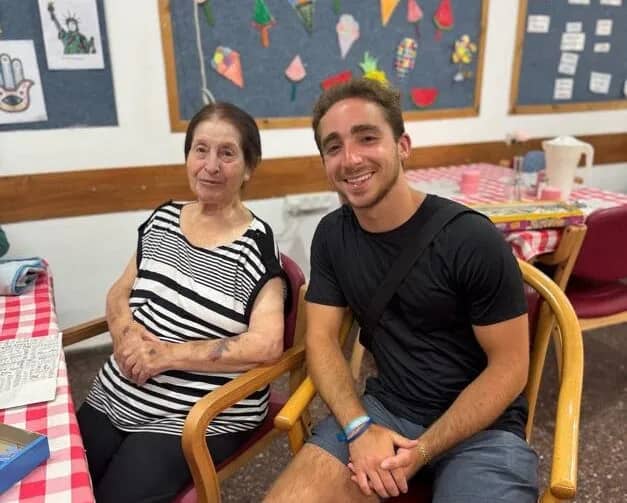
We met soldiers along the way. My Hebrew isn’t great, but we managed. We asked simple things—how are you, how are you holding up, what do you do when you’re off duty? They just wanted to relax, see family, eat, and breathe. It hit me that these guys were 18 or 19 years old. They were younger than me but had already lived through so much. It gave me a new level of respect.
We also visited the Nova festival site, the burning car memorial, and the bomb shelter where Hirsch Goldberg-Polin was abducted. It was heartbreaking. Then we went to Sderot, to the police station memorial. I’d seen it the year before—just gravel and rubble. Now it’s a beautiful space with eighteen stone pillars, built from the remains of the station. They even turned old rocket fragments into art. Hearing the story of how terrorists overtook the building and how one brave man took out the sniper—it was unreal. To see what Israel rebuilt there only a year later—it’s so inspiring. It shows how this country turns tragedy into beauty.
If someone was unsure about joining a Birthright Israel Volunteer trip, I’d tell them: one week can change you. You may think it’s short, but the impact you make in those seven days is massive. You’re helping families, soldiers, farmers—real people who need it right now. By giving, you become part of something bigger.
To the donors who make this possible, I’d say thank you—truly. Since the war, traveling to Israel alone is difficult and expensive. Many of us are college students; we couldn’t do this without donor support. They don’t just make it possible for us to visit—they make it possible for us to help and make a difference. That’s something you can’t put a price on.
I wouldn’t be there without the donors, and I know that. I’m deeply grateful for the chance to do something meaningful for the people and country I love.
Related Posts
Why My Birthright Israel Trip Changed Me
In 2004 I moved from Sheepshead Bay, Brooklyn to a small suburban town in New Jersey where I became ...
Lone Soldier Families Reunited in Birthright Israel Volunteer Ceremony
Last week, our Birthright Israel Volunteer program had the privilege of welcoming an extraordinary g...
On a Birthright Israel Volunteer Trip for Participants with Disabilities
My name is Annie Michaels, I’m 32, and I live in Chicago. I was part of a Birthright Israel Voluntee...

Birthright Israel: A Journey That Changed Me Forever
I could write novels upon novels about how beneficial Birthright Israel is and how this trip changed...