

January 22, 2025
Yesterday’s Seedling is Tomorrow’s Tree


“People who don’t know their past—their present is vague, and their future is a mystery,” my Birthright Israel madricha told us at Ben Gurion Airport. This not only became the theme of my trip, it resonated as the theme of my life and the enduring story of the Jewish nation.
I was born in France to a traditional Sephardic family, with Moroccan and Tunisian roots. My parents decided to move to Los Angeles when I was five years old, driven by the rise in antisemitism in France. My father, born in Morocco, moved to Israel as a child to escape religious persecution, while my mother, born in France to Tunisian parents, grew up hearing stories of exile and survival. Her ancestors had lived in Israel for more than ten generations; my maternal great-grandfather’s passport listed his birthplace as “British Mandate Palestine.” I come from generations of proud Zionists who understood the pain of exile. I myself felt this exile throughout my life.
When I was four, an antisemitic incident prompted my parents to decide to leave France. My French daycare teacher cruelly segregated Jewish children and excluded us from attending a field trip. Another time, my mother and I were walking hand in hand when a man spat on us, shouting, “Dirty Jews, you don’t belong here.” In Los Angeles, I was mocked for my Jewish identity in school; after I sneezed, a classmate told me, “Get your dirty Jewish germs away from me!”
These experiences, though painful, helped me find my purpose: standing against antisemitism. In middle and high school, I discovered my talent for writing and advocacy, and spearheaded projects to raise awareness of global antisemitic hate. I wrote articles in the school newspaper about events like the Hypercacher supermarket attack in France and tried to bring attention to the story of Ilan Halimi, a victim of an antisemitic kidnapping and murder. By the age of 15, I had visited the LA Holocaust Museum over 40 times, even answering visitors’ questions about Jewish history.
Despite my passion, I felt like an outsider. In France, I was seen as a Jew or an American. In Los Angeles, I was the French girl. I never felt like I belonged, yet I always identified as a Jew in exile. Conversations with my parents and grandparents revealed their dream to return to Israel. I felt that yearning in my heart, in my soul, in my gut: one day I would return to the land of my ancestors, the only land where I wasn’t an outsider but an Israelite. I was one among millions who were forced to exile, but the exile would end with me, B”H.
In college, I majored in Middle Eastern Studies and minored in Religion, so I could better understand the complexities of the Middle East. As a board member of Students Supporting Israel, I organized events and fundraisers, often facing backlash for my Zionist views. I corrected professors who called Israel “Palestine,” and one who wrote an entire textbook that claimed that the State of Israel was inhabited by European Jews with no historical ties to the land, and that Jews had not lived there for generations. This false narrative erased the history of Jews from the Middle East and denied the experiences of families like mine. Such incidents deeply upset me and fueled my activism.
I desired to visit Israel but could not for a long time, for reasons outside my control. I was in true exile and felt the yearning in my core. Then, on June 16th, 2024, I finally embarked on my Birthright trip. The moment I landed, the connection was surreal and I could not stop crying. Initially, I was nervous about fitting in as a married woman with Sephardic customs, but I reassured myself that even if I didn’t connect with the group, I would connect with the land and Israelis, who made me feel at home. But from the first day, the camaraderie of the group eased my fears. A mishap with my luggage led participants and staff to lend me their clothes until my bag was retrieved. Their kindness was the true essence of the Jewish nation, lending a helping hand to a stranger. From then on, the trip only became more amazing.
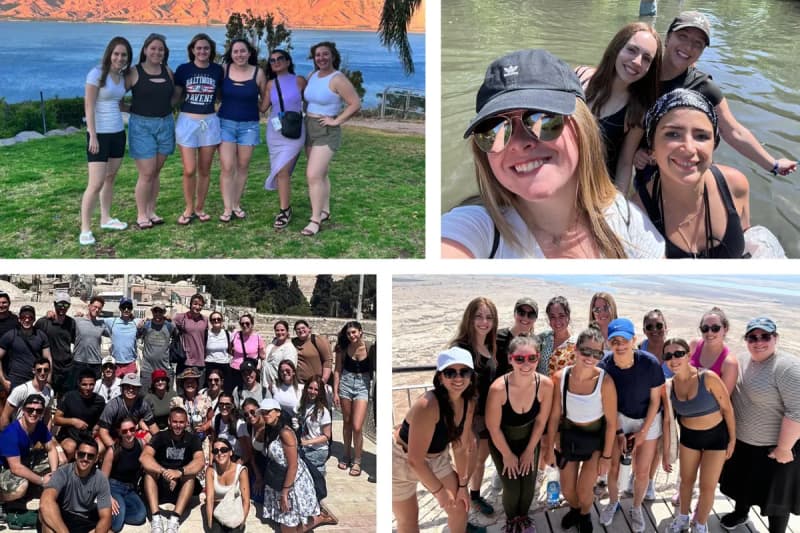
We came from all walks of life: Orthodox, traditional, secular, some who had never tied tefillin or lit Shabbat candles, and even one participant who had never attended a Shabbat dinner. I loved observing everyone’s and my own evolution throughout the trip. From being closed off I became a social butterfly, while others who felt they were outsiders because they lacked Jewish knowledge were proud to connect with their heritage.
As we traveled, our itinerary highlighted Israel’s past, present, and future. In the north, we picked fruit as volunteers, visited Kibbutzim, and engaged with communities displaced after October 7th. Meeting Beber, a Moroccan-born elder, reminded me of my father’s journey and the resilience of our people. And I instantly connected with Hila, one of the Mifgash Israeli participants, who was surprised to learn about antisemitism in the U.S. Seeing the strength of Israelis who had been displaced by war—yet maintained hope and determination—was incredibly inspiring. The view of the Kinneret is one I still see in my dreams: the peace and greatness of the land of Israel.
Jerusalem was the emotional heart of our trip, where the tears flowed and we became a family. Those who had never been to Israel before were awestruck to see all kinds of people walking and living freely, contrary to narratives from the media. Muslims, Christians, Jews, people of all ethnicities and nationalities—we saw everyone coexisting.
From lighting Shabbat candles to praying at the Kotel and speaking with a Holocaust survivor, every moment was deeply spiritual. Yad Vashem was sobering evidence of the necessity of Israel as a haven for Jews. Har Herzl reminded us of the thousands of brave souls who fought and lost their lives to make sure that another Holocaust or October 7th never happens again. We completed our tour of Jerusalem by seeing its unique underground water tunnels. As we were squeezed tightly between the walls of the tunnels, all the Israelis started singing, making a somewhat uncomfortable passage in the dark filled with laughter and song. Our people, their positivity, and our rich history never fail to amaze me.
In Tel Aviv, we learned that our group would visit and tour the Schneider Children’s Medical Center. This was the hospital that received all the child hostages who were released from Gaza in the deal that took place in November 2023. Dr. Efrat Bron-Harlev told us that on October 7th, while everyone was still in the dark about the scale of the unfolding horrors, the hospital staff managed to move all their patients to safety, and even raised everyone’s spirits with song and dance.
There were miraculous stories like that of Sharon Cunio and her twin girls. After they became separated, in captivity Sharon bravely told a Hamas terrorist that the babies they heard crying in another room were her daughters. They were reunited, though Sharon’s husband remains a hostage in Gaza. There was another story of a teenage girl who locked herself in her hospital room upon learning that her loved ones were murdered. After a couple of days, her friends visited her; eventually they laughed and made TikTok videos, like teenagers should. These stories showed the warmth and care of the hospital staff, and their efforts to make everyone feel safe and accommodated, after the trauma they had endured.
We were led into the cardiac unit. It was a difficult sight: a newborn infant with a mechanical valve, and a 3-year-old girl attached to a machine. The patients were not only Jewish. There were Muslim and Christian families alongside Orthodox Jews. Children are children, and we are all human beings.
I was so inspired by the hospital donors. They were Jews from all walks of life, who came here at this moment to make a difference. It is ingrained in us to help each other. When someone in our nation gets hurt, we hurt as a collective. Seeing everyone there, ready to help, reinforced my pride of belonging to the Jewish tribe. I was honored to speak to the donors about my journey. I told them that I will continue to carry the valuable lessons and incredible experiences I had on Birthright Israel.
Our trip concluded with visits to Masada and the Dead Sea, where we celebrated group members’ bar and bat mitzvahs. It was very emotional; everyone grew on this trip. Our experience with the Israeli land and people was raw and authentic. Everyone truly connected at the end, no matter the initial barriers. Whether lighthearted or solemn, every experience was meaningful and interconnected.
This journey made me see Israel like never before, making it difficult to readjust to life in New York, where I now live and often feel the need to hide my identity. The warmth and acceptance I felt in Israel were transformative, and there was not a single instance of feeling unsafe. I felt safer in Israel in the middle of a war than I ever did in the United States. Israel is the only country where I can be openly Jewish, wear a Magen David, or raise an Israeli flag without being targeted and discriminated against.
Birthright Israel brought me so much joy and peace. I am profoundly grateful to the donors who made this beautiful journey possible. I hope to become a madricha on a Birthright Israel trip soon, to share the same connection and support I received.
Related Posts
Highlights from Our Inspiring Winter Season
The winter season has begun, and we’re thrilled to share the exciting journeys of our classic 10-day...

VIDEO: My Birthright Israel Trip Explained
Lindsay Nathanson is a 2019 Birthright Israel alumna from Philadelphia, PA. She is currently studyin...

Reflections on an Accessible Trip to Israel
I am a Jewish Inclusion Fellow at RespectAbility, but I’ve always had a complicated relationship wit...
Why My Birthright Israel Trip Changed Me
In 2004 I moved from Sheepshead Bay, Brooklyn to a small suburban town in New Jersey where I became ...