

April 1, 2025
Birthright Israel is Unforgettable. It’s Everything.
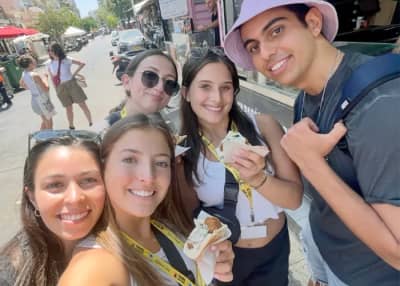
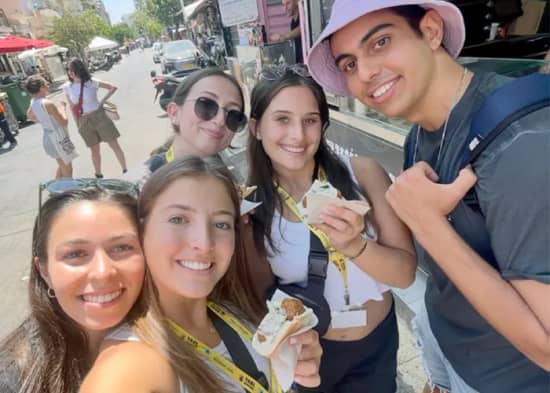
I grew up in a small town outside of Philadelphia. My mom enrolled me in a Jewish preschool, so I was immersed in Jewish culture from early on. I remember chopping fruit for Shabbat and making challah. I loved it. I was always a curious kid, eager to learn, and I’d follow along with my older friends in Hebrew school. But I had this vivid memory of being really young, maybe seven, and being brought into the library and told to pick out a book. I remember thinking, "I can’t read any of these." I felt out of place. I ended up deciding that Hebrew school wasn’t for me. That kind of set the tone in my family — none of my siblings went either.
Still, Judaism was always there. I had cousins in Long Island and Westchester who were really involved, and when I stayed with them, I’d go to their Hebrew school classes. Part of me wondered if I should’ve stuck with it. When I moved to New York City in sixth grade, I found myself surrounded by other Jewish kids — but not many of us had bar or bat mitzvahs. We celebrated the big holidays, but we didn’t have that strong synagogue community. I never belonged to a synagogue in the city.
My Jewish identity wasn’t always top of mind. It was something I was proud of, but it wasn’t central to my routine. That changed in college. I went to the University of Miami, where the Chabad was huge. The dorm food was really bad, so one Friday night we decided to try Shabbat dinner at Chabad. I ended up coming back every Friday. It was warm and welcoming, and it connected me back to Judaism in a deeper way.
My family always celebrated the holidays. Growing up, the Jewish holidays were when we’d see family — drive hours early in the morning just to make it. So being Jewish was tied up in family and tradition. As I got older and met more Jewish friends in college, I realized how different everyone’s experience was, and that made me even more passionate about my own.
I always knew that Birthright Israel would be my first trip to Israel. My mom always wanted to go. My dad is very protective — he was nervous about me going because of the conflict. But my brother went the summer before I did, and it changed his life. He’d had a rough semester, only knew one person on the trip, and came back with a whole new group of friends and a new perspective.
I graduated college in 2023, and my friends and I signed up for a New York-based Birthright Israel trip. Right off the bat at the airport, we clicked with the group. Everyone was in that post-grad headspace — ready for one last adventure before the real world. We got really lucky. We had Israeli soldiers with us for the full 10 days, which was rare. We bonded with them immediately. We wanted to learn everything about their lives. They were so mature and confident. I really saw them as role models for how to be an adult, how to be resilient, proud, lean forward, and lead confidently with my Jewish identity.
There was one moment early on when the soldiers weren’t allowed to do a hike with us because of their attire — it didn’t meet IDF guidelines. Our whole group was like, "If they’re not going, we’re not going." So, we found a shorter hike so they could come. From then on, we were ride-or-die for our soldiers. We met their parents. We wanted to room with them. They became family.
They also challenged us. They came with misconceptions about American Jews—that we were disconnected or indifferent — and we got to change that. We showed them that we cared deeply. They told us they were going to go home and tell their friends that American Jews are awesome. That back-and-forth made our connection even stronger.

We had deep conversations, even arguments, especially one night at a kibbutz. Some of our soldiers had worked at checkpoints at the Gaza border, having to turn away innocent families. Others had been on missions in the middle of the night and had seen unspeakable things. It was intense and emotional, and it made us realize how complex everything is.
One of the most powerful moments of the trip was my bat mitzvah at the Kotel. I wasn’t expecting it to hit me so hard. My great uncle Allen Katz was really sick at the time. On the bus, they handed out cards for us to write prayers. I was sobbing as I wrote, wishing for his health to improve. I tucked the note into the wall and had this moment of connection and spirituality I had never experienced before. I brought back red strings for my whole family—my uncle wore his until the hospital made him take it off. He lived for another six months. That day changed me.
Another memory I’ll never forget was at Yad Vashem. We sat in a circle and shared stories — about antisemitism, about our Jewish journeys. Even the goofballs on our trip opened up. I’d never seen that side of them before. That day showed me how much we’d all grown, and how real our bond was.
After the trip, all of us who lived in New York kept seeing each other. One of the soldiers we met, Chen, became one of my closest friends. She was a combat soldier in the IDF and was at the Nova Festival on October 7. She survived by hiding in a bush for hours. She called me as soon as she got back to safety. I stayed on the phone with her for days after. She went back to fight, but eventually came home and started therapy. She decided to tell her story, and now she lives in New York.
She’s become part of our community here. She’s met my whole family. One time in New Jersey, a woman overheard her story at a restaurant and started crying. She said, "Thank you for everything you’ve done." It meant so much to Chen — to be embraced by Americans like that, especially after everything she went through.
Birthright Israel completely changed my perspective. I now know I want to raise a Jewish family. I want to carry forward the culture, the traditions, the sense of community. Before Birthright Israel, I might not have said that. But after everything that’s happened — after the trip, after October 7th — I can’t imagine not being part of this. I’ve started showing up more. I wear my Jewish star every day. When I started a new job, I wasn’t sure how it would be received. But my boss — who isn’t Jewish — told me, "Don’t you ever take that off. Be proud."
If someone’s on the fence about donating to Birthright Israel, I’d tell them this: not everyone can afford a trip to Israel. Birthright Israel makes it possible. It opens the door for people like me who grew up proud but not connected, who are searching for something deeper. You don’t know how it will change your life until you go. But once you do, there’s no going back. It’s unforgettable. It’s everything.
Related Posts

Birthright Israel Summer 2024 Program Snapshot
Did you know that 13,500 Jewish young adults will take part in Birthright Israel programs this summe...

For This Alumna, Everything Changed After Birthright Israel
Everything changed after Birthright Israel. Judaism was pure boredom to me up until I stepped off th...

Birthright Israel Awards Distinguished Alumni in Houston
On January 16, 2025, Houston’s Jewish community gathered to celebrate the 25th anniversary of Birthr...

Discovering the Real Israel on Birthright Israel
Growing up in Massachusetts, my family went to temple every so often. I started going less and less ...