

August 26, 2025
My Journey Creating Ripples of Leadership with Birthright Israel

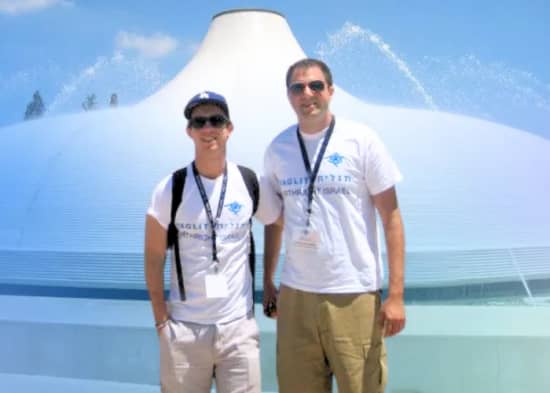
I grew up in Los Angeles, third generation, in a Reform Jewish household. We always celebrated the holidays, and Hanukkah was my favorite. I loved playing dreidel, lighting the candles, and gathering with close friends and family. My parents hosted a Hanukkah party every year, and we were lucky to have friends who made the best latkes in town. Passover was another highlight. My dad led the Seder and made it come alive with storytelling and singing. I used to joke that I was one of the few kids who liked going to Hebrew school on Sundays. My 8th grade class had 4 kids in it, and I continued through confirmation. My Jewish identity growing up was not necessarily wrapped in observance or religiosity but definitely in culture, family, tradition, and memories.
Israel, though, was not really a core part of my upbringing. I had some dear Israeli family friends, so I heard about Israel from them, but it wasn’t something I felt personally connected to beyond always wanting to go “when the time was right.” That started to feel possible after seeing the experience of my sister – she’s six years older than me and went on a Birthright Israel trip years before I did. She raved about it. I thought, “Someday, I’d love to go.” And after my freshman year at Penn, I got the chance through Chabad on campus.
That ten-day trip was a whirlwind. The moment I landed and heard, “Welcome home,” really stuck with me. Even though I had never been there before, I felt connected. That sense of belonging was powerful. There were so many moving experiences – the Kotel, Masada, and especially the mega-event with thousands of young Jews from all over the world. I had never seen that many young Jews together in one place, just celebrating being Jewish. It was moving and inspiring.
After that trip, I knew I wanted to go back. I didn’t know when, but the next year I learned about a brand-new program called Birthright Israel Excel. I applied and ended up in the very first Excel cohort in 2011. I spent ten weeks in Tel Aviv, working at a venture capital firm in Herzliya Pituach. It was an incredible experience. I got exposure to early-stage investing, meeting entrepreneurs, doing research, and really learning the basics of what has become my career as a technology investor. Now I focus on later-stage investing, but Excel gave me a foundation and opened my eyes to the possibilities.
It also gave me cherished friends. That Excel network has become something very special. We realized even back then that if we kept this community together and kept adding ambitious, talented young people, it would only grow stronger. And it has. This past summer was Excel’s fifteenth (!), and today there’s a phenomenal network of alumni – people who invest together, build companies together, lead philanthropic initiatives together. Just last week, I was at an impromptu Excel alumni happy hour in New York. That’s what I mean when I say Birthright didn’t just give me trips to Israel – it gave me a dynamic community, and it accelerated my Jewish leadership journey.
 Start-Up Nation during my Excel summer and admired the culture of resilience, risk-taking, and chutzpah that enabled such rampant innovation. So, as we drove around, I would point out the hubs of innovation – the R&D centers in Herzliya, the universities, the places where Israel’s high-tech ecosystem was thriving. Even though it wasn’t formally on the itinerary, I wanted participants to get a taste of the ingenuity and technological impact coming out of the country.
Why is Israel such a hub for innovation? A lot of it goes back to the land itself – turning desert into farmland, creating sustainability out of necessity. But maybe the biggest factor is the IDF. At 18, Israelis serve in the army. They don’t go straight to college; they’re defending their country and learning real leadership and technical skills. By the time they finish, they’re more mature than most 21-year-olds anywhere else. Some are already captains leading large groups through highly stressful and serious operations during war, where calm and decisive leadership is imperative. Many serve in cybersecurity and intelligence units where they’re working with cutting-edge technology. They come out of those experiences saying, “I want to build something and make an impact.” That mix of maturity, skills, and entrepreneurial spirit fuels Israel’s innovation culture.
Start-Up Nation during my Excel summer and admired the culture of resilience, risk-taking, and chutzpah that enabled such rampant innovation. So, as we drove around, I would point out the hubs of innovation – the R&D centers in Herzliya, the universities, the places where Israel’s high-tech ecosystem was thriving. Even though it wasn’t formally on the itinerary, I wanted participants to get a taste of the ingenuity and technological impact coming out of the country.
Why is Israel such a hub for innovation? A lot of it goes back to the land itself – turning desert into farmland, creating sustainability out of necessity. But maybe the biggest factor is the IDF. At 18, Israelis serve in the army. They don’t go straight to college; they’re defending their country and learning real leadership and technical skills. By the time they finish, they’re more mature than most 21-year-olds anywhere else. Some are already captains leading large groups through highly stressful and serious operations during war, where calm and decisive leadership is imperative. Many serve in cybersecurity and intelligence units where they’re working with cutting-edge technology. They come out of those experiences saying, “I want to build something and make an impact.” That mix of maturity, skills, and entrepreneurial spirit fuels Israel’s innovation culture.
Start-Up Nation during my Excel summer and admired the culture of resilience, risk-taking, and chutzpah that enabled such rampant innovation. So, as we drove around, I would point out the hubs of innovation – the R&D centers in Herzliya, the universities, the places where Israel’s high-tech ecosystem was thriving. Even though it wasn’t formally on the itinerary, I wanted participants to get a taste of the ingenuity and technological impact coming out of the country.
Why is Israel such a hub for innovation? A lot of it goes back to the land itself – turning desert into farmland, creating sustainability out of necessity. But maybe the biggest factor is the IDF. At 18, Israelis serve in the army. They don’t go straight to college; they’re defending their country and learning real leadership and technical skills. By the time they finish, they’re more mature than most 21-year-olds anywhere else. Some are already captains leading large groups through highly stressful and serious operations during war, where calm and decisive leadership is imperative. Many serve in cybersecurity and intelligence units where they’re working with cutting-edge technology. They come out of those experiences saying, “I want to build something and make an impact.” That mix of maturity, skills, and entrepreneurial spirit fuels Israel’s innovation culture.
For me, there’s a connection between Judaism and innovation. Judaism is about asking questions. For centuries, rabbis have debated, argued, and wrestled with complexity. That’s how Jewish tradition grows – through inquiry and dialogue. Innovation works the same way. As an investor, my job is to study trends, analyze disruption, and ask key questions about what technologies are ready for adoption and why. In both Judaism and technology, it’s about questioning, learning from history, and pushing toward progress.
Birthright has always encouraged that kind of questioning. In a world full of simplistic, one-sided narratives about Israel, Birthright gives young Jews the space to wrestle with complexity and ask hard questions. That’s part of why I think it’s so important. As the amazing Birthright VP of International Educational Strategy Zohar Raviv says, Birthright is “not a sightseeing trip, it is an insight-seeing trip!”
Over time, my involvement with Birthright deepened. After years of co-chairing the Birthright Excel Summits in New York, bringing Excel alumni together to learn from one another and to hear from inspiring speakers, I was invited in 2021 to join the Birthright Israel Foundation Board. That has been an honor. It is a wonderful group of generous donors who serve on the national board. I am proud to be an example of an alum who grew up with limited connection to Israel but who benefited tremendously from my Birthright experiences, and I am highly motivated to pay it forward.
I’ve seen firsthand how Birthright accelerates Jewish leadership. My own leadership development has been shaped by it. It’s allowed me to build community with alumni, entrepreneurs, donors, and other Jewish leaders. Some of my closest friends, even my first roommate in NYC who gave a toast at my wedding, came into my life because of Birthright.
Growing up on the beach my whole life, I have always loved skipping rocks. The smooth rocks destined for many bounces. Even the challenging rocks, where you think there is no way. With each throw, you never know how many bounces you’ll get, but each bounce creates a ripple. That’s what investing in Birthright Israel is like. Not every rock will bounce five times, but even a couple of bounces can create a ripple effect that touches countless others. Each participant is a rock skipping across the water, and each bounce sends ripples into their communities, their campuses, their careers, their families.
For me, the impact has been clear. I went from a Reform kid in Los Angeles with little connection to Israel, to a Birthright participant, to an Excel fellow, to a trip staffer, to an alumni leader, to a national board member. Along the way, I’ve built friendships in Israel, invested in companies founded by alumni, and joined a community that continues to shape my life.
Birthright Israel is an investment in future generations. With nearly one million alumni today, imagine where we’d be without it. Each ripple strengthens Jewish identity, builds leaders, and creates allies who understand the complexity of Israel and Jewish life.
Related Posts

Birthright Israel Summer 2024 Program Snapshot
Did you know that 13,500 Jewish young adults will take part in Birthright Israel programs this summe...

Birthright Israel Awards Distinguished Alumni in Houston
On January 16, 2025, Houston’s Jewish community gathered to celebrate the 25th anniversary of Birthr...

Discovering the Real Israel on Birthright Israel
Growing up in Massachusetts, my family went to temple every so often. I started going less and less ...

Hamptons Community Gathers to Support Birthright Israel
On Friday, July 25, we gathered at the Hamptons home of Lisa Kadin and William Spiegel to celebrate ...